

What the Universal Commerce Protocol (UCP) Means for the Future of SEO
The Universal Commerce Protocol. Or UCP.
If you work in SEO and eCommerce, this announcement deserves more than a quick read.
Not because it introduces a new tactic. But because it signals a structural shift in how search, commerce, and decision making start to connect.
To understand what UCP means for SEO, we first need to step away from rankings, keywords, and traffic charts.
And look at how search itself is evolving.
Why UCP exists now
Search engines are no longer only retrieval systems. They are becoming decision systems.
With the rise of AI driven experiences, search is increasingly expected to:
- Compare options
- Evaluate products
- Assess merchants
- Recommend outcomes
- Sometimes even complete parts of the transaction
This shift is visible across multiple Google surfaces and products. It is not limited to organic search.
Google needs a way for machines to reliably understand commerce.
Not just content. But verifiable commerce signals. Products, prices, stock status, shipping, returns, and who stands behind the transaction.
That is where UCP comes in.
What UCP actually is, in simple terms
UCP is an open protocol designed to standardise how commerce data is described and exchanged across the web.
It focuses on core commercial entities such as:
- Products
- Prices
- Availability
- Shipping
- Returns
- Merchant identity
- Policies and fulfilment signals
The key idea is consistency.
Today, every platform and website exposes this information in a different way. UCP tries to bring one common structure that machines can understand.
This is not just about helping Google. It is about enabling AI systems, agents, and platforms to evaluate commerce at scale.
That distinction matters for SEO.
How the mechanics of search are changing
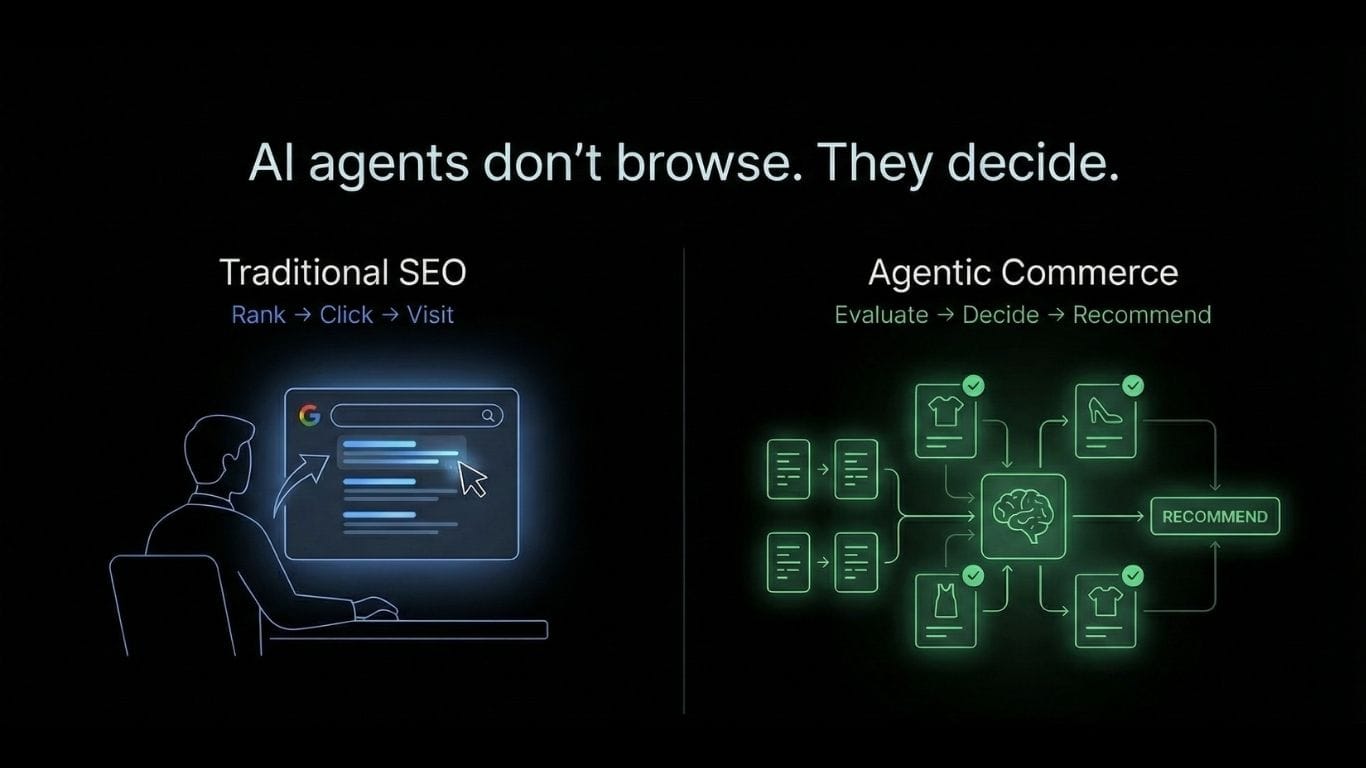
Traditional search worked roughly like this:
- A user types a query.
- Google retrieves relevant documents.
- Results are ranked.
- The user clicks.
Even when ranking systems became more complex, the end goal remained the same. Send the user to the best page.
Agentic systems change that flow.
Instead of asking “which page should rank first?”, they ask:
- Which product fits the intent best?
- Which merchant is reliable?
- Which option should be recommended?
- Which outcome should be prioritised?
In that model, pages are no longer the primary object.
Entities are.
And entities need to be clearly defined.
From ranking pages to being understandable by machines
This is the first fundamental shift for SEO.
AI agents do not browse websites the way humans do.
They do not skim headings. They do not read persuasive copy.
They do not interpret tone. They compare structured signals.
If your products, prices, availability, and policies cannot be clearly interpreted, you are not ranked lower.
You are ignored.
This changes the SEO question from: “How do we rank better?”
To: “Can machines correctly understand what we offer, how we operate, and whether we can be trusted?”
Why structured commerce data becomes foundational
Structured data has existed in SEO for years.
But it was often treated as an enhancement.
- Nice to have.
- Helpful for rich results.
- Rarely critical.
UCP pushes structured commerce data into a different role.
It becomes infrastructure.
When your:
- Product feeds
- On site content
- Pricing
- Availability
- Shipping and returns
- Merchant policies
are aligned and consistent, machines can reason about your business.
When they are not, trust breaks.
In agentic systems, trust is based on data and consistency.
That is why schema, feeds, and backend data can no longer be treated separately.
They all belong to the same system.
Visibility without clicks becomes normal
One of the most uncomfortable implications of agentic commerce is reduced clicking.
AI answers and assistants can resolve intent without sending traffic.
This does not mean visibility disappears.
It changes form.
Visibility increasingly means:
- Being included in comparisons
- Being shortlisted by agents
- Being recommended
- Being selected as the preferred option
So the KPI question for SEO evolves.
Not only:
“How much traffic did we get?”
But:
“Were we considered at all?”
That is a harder question.
And a more strategic one.
The merchant becomes an SEO entity
Another important shift introduced by UCP is the elevation of the merchant.
Agents do not only evaluate products.
They evaluate sellers.
They look for signals such as:
- Consistent pricing
- Clear policies
- Reliable availability
- Operational credibility
- Historical trust signals
This pushes SEO beyond content and links.
SEO starts touching:
- Operations
- Customer experience
- Commerce strategy
- Data governance
The wall between “marketing SEO” and “business reality” becomes thinner.
What does not change
It is important to say what UCP does not make obsolete.
- Content still matters.
But its role shifts from persuasion to explanation and context.
- Technical SEO still matters.
But less as optimisation tricks and more as architectural correctness.
- Links still matter.
But less as shortcuts and more as trust reinforcement.
- SEO does not disappear.
It matures.
What good SEO teams should start thinking about now
This is not a checklist you can tick off.
It is a change in how SEO needs to be approached.
Strong SEO teams will:
- Treat structured data and feeds as core parts of SEO, not extras
- Align content, feeds, and policies instead of working on them in isolation
- Work more closely with product, operations, and development teams
- Think in terms of entities and commerce journeys, not just URLs
Most importantly, they will stop asking only:
“What will rank?”
And start asking:
“How will machines understand us?”
My Final thoughts
UCP is not a finished product, obviously.
It shows a direction. It shows how search is changing, with AI increasingly acting as the interface between users and commerce.
For SEO, this is not a threat.
But it does separate shallow work from serious SEO.
SEO that understands how commerce really works, data, operations, trust, will matter more than ever.
SEO is no longer only about driving traffic. It is becoming part of how machines understand and evaluate businesses.
That comes with more responsibility. And more opportunity.


